Heliospheric Physics Research Group (HPRG), University of Graz
Member of the European Heliophysics Community and ESA Space Weather Service Network
Fundamental Research: Large scale structures in interplanetary space - from Sun to Heliosphere
The dynamic interplay between coronal mass ejections (CMEs), background solar wind structures and the evolution of their sources on the Sun changes the heliosphere on various temporal and spatial scales. This has effects on the propagation behavior of individual events. Modelling efforts showed that reliable Space Weather forecasts are difficult to make, due to large uncertainties in the available observational input data as well as complex interaction processes. We are working in national and international projects on better understanding the physical interaction processes and evolution of CMEs embedded in the background solar wind. The research results are basis for developing and improving operational models for Space Weather forecasting (R2O process). The research group is financed through national and international funding bodies (FWF, FFG, ESA, ISSI, EU).
Current projects (2026+):
- FWF ESPIRE (Earth and Space Weather: Interdisciplinary research) - joint with TU Graz
- FWF (From L1 to the Ground: Global Magnetospheric Dynamics) - joint with IWF Graz
- FWF ESPRIT (Revisiting CME parameters observed by Metis on Solar Orbiter) - PI Yara De Leo
- iSWAT COSPAR initative (H1+2 Clusters team member and advisor)
- ISSI teams (C. Verbeke, L.M. Mays; G. Barnes)
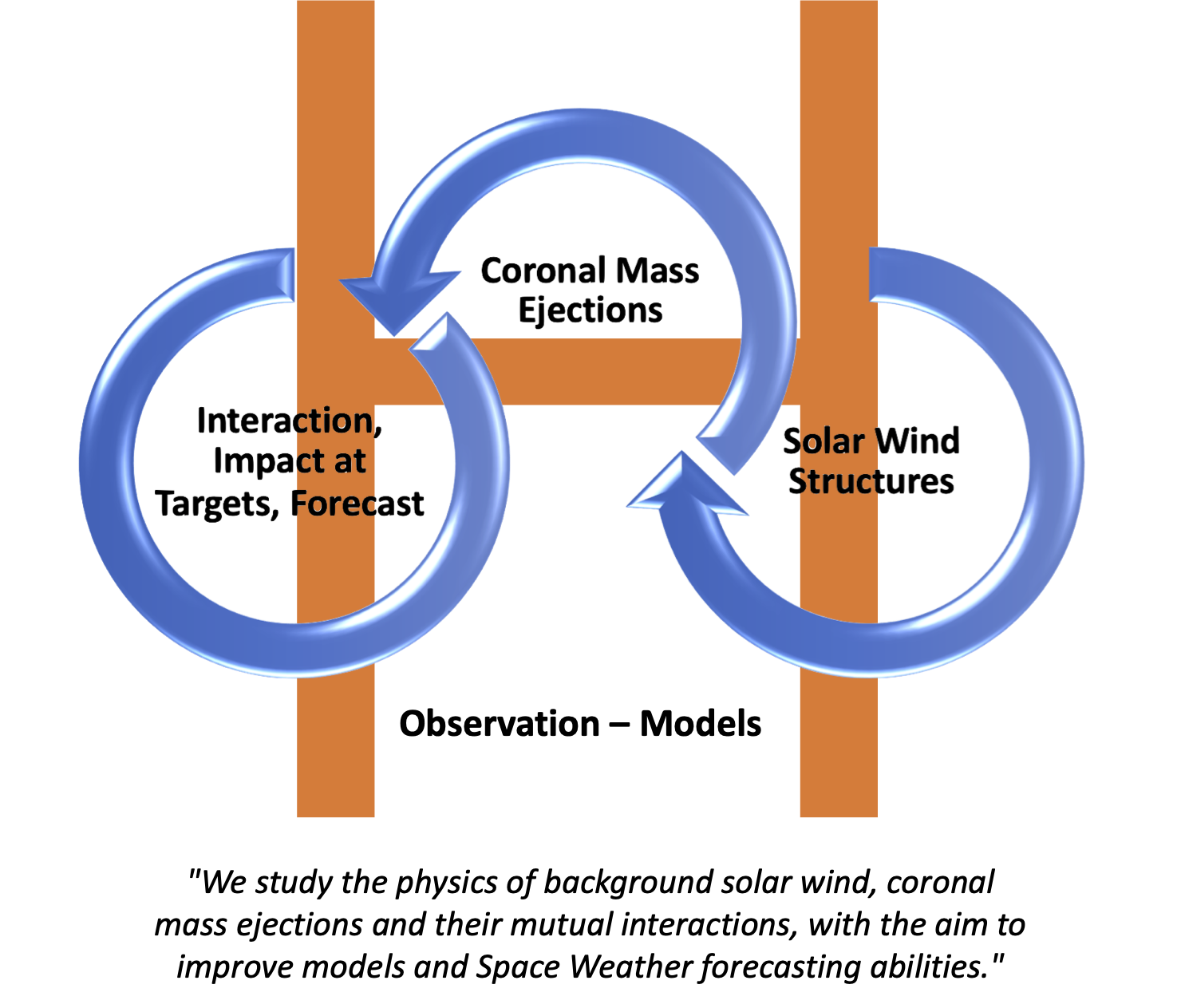
Applied Research: Space Weather service provision of daily/hourly updated information on solar wind structures, CME forecasting and radio bursts
To better understand the physics behind Space Weather phenomena and to prepare for improved Space Weather forecasting, the "Heliospheric Physics Research Group" is permanently working in international programs. In that, we are providing services for the Space Weather community to help peers and end-users in understanding the processes and impacts of solar activity on Earth and its modern technology:
- ESA-Space Safety Programme (Heliospheric Expert Team - ESWF, ESWF24, STEREO+CH, DBEM and Ionospheric Expert Team - SODA)
- e-CALLISTO (AUSTRIA-UNIGRAZ radio telescope - nowcast of radio type III bursts)
- MiniMax (SCOSTEP/PRESTO - forecast of solar wind high speed streams and filament eruptions)